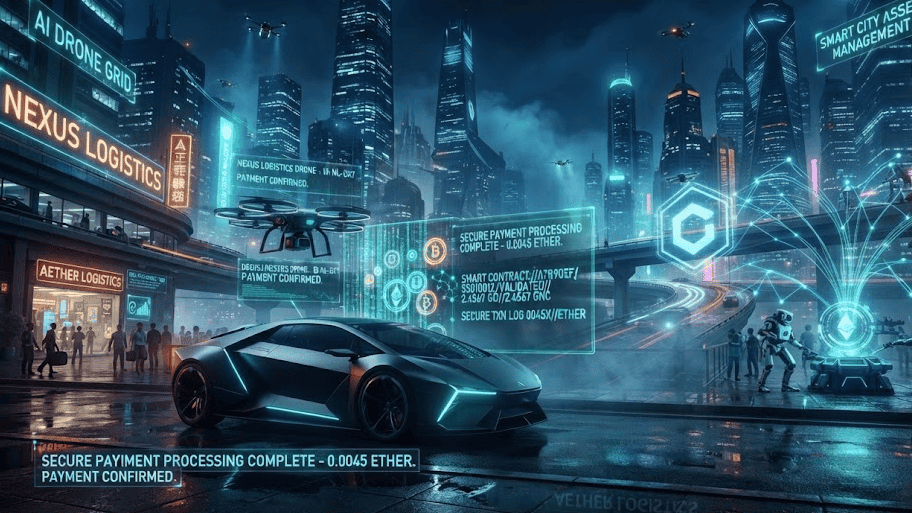
Imagine a near future. An autonomous electric delivery drone is flying over a city when its sensors detect a degrading battery cell and an approaching storm. Without consulting a human, the drone pings a nearby automated charging pad. The pad responds with a price for an emergency rapid charge based on current grid demand. The drone’s AI instantly calculates that paying the premium is cheaper than aborting the mission or risking a crash. A digital handshake occurs. Microcents are transferred. The drone lands, charges, and completes its route.
No credit card was swiped. No human manager approved the expense. No invoice was sent.
This scenario is no longer science fiction. It is the vanguard of the Autonomous Economy—a paradigm shift where machines are not just tools of production, but active economic agents capable of negotiating, buying, and selling on their own behalf.
Welcome to the era of Machine-to-Machine (M2M) commerce.
For machines to pay machines, three technological pillars had to mature simultaneously:
We are currently in the "dial-up" phase of the autonomous economy, but early use cases are already proving the concept:
The drive toward an autonomous economy isn't just about technological novelty; it is about eliminating the profound inefficiencies of human involvement.
Humans sleep. Humans make emotional decisions. Humans take time to read emails and approve purchase orders. In a hyper-connected, real-time world, waiting three hours for a procurement manager to approve a $2.50 transaction costs more in lost time than the transaction itself. Machines, however, operate at the speed of light, 24/7/365. They optimize for pure efficiency, executing thousands of micro-transactions per second to achieve the best possible outcome.
While the promise of frictionless commerce is alluring, handing wallets to algorithms introduces unprecedented risks.
The Flash Crash of Things: In 2010, algorithmic trading bots caused the US stock market to plummet nearly 1,000 points in minutes before recovering. Imagine a similar "flash crash," but instead of stocks, it involves the automated purchasing of raw materials, bandwidth, or electrical power by millions of interlinked machines. A sudden, inexplicable price spike triggered by machine panic could cause physical shortages in the real world.
Security and Kidnapping: If an autonomous truck holds a digital wallet containing thousands of dollars to pay for tolls, fuel, and maintenance, it becomes a target. Hackers wouldn't just steal data; they could digitally "mug" the truck, draining its wallet and leaving it stranded without the funds to complete its journey.
The Liability Black Hole: If Machine A bankrupts Machine B through a series of bad automated contracts, who is liable? The owner of Machine A? The programmer who wrote the AI? The creator of the smart contract? The law is entirely unprepared for a scenario where a non-sentient entity commits financial suicide.
Does the autonomous economy mean humans will be rendered obsolete? Unlikely. Instead, our role will shift from operators to architects.
Humans will no longer do the grocery shopping for their smart homes, but they will define the parameters of the smart home’s budget. We will set the "guardrails"—dictating that the home AI cannot spend more than $500 a month on electricity, or that it must prioritize green energy providers over cheap ones.
We will become the central bankers and legislators of our own personal micro-economies, managing the AIs that manage our machines.
For 5,000 years, money has been an inherently human invention, designed to mediate trust between people. The birth of the autonomous economy challenges that assumption. We are entering an age where the primary consumers of financial services will not have a pulse.
When machines start paying machines, money ceases to be just a medium of human exchange. It becomes the fundamental language through which our smart cities, robots, and digital networks negotiate their shared existence. The autonomous economy isn't just changing how we buy things—it is changing what it means to be an economic actor in the 21st century.